Africa's Businesses Are Running on WhatsApp. Here Is What Comes Next.
39 million businesses across Nigeria alone are managing internal operations through group chats and spreadsheets. The infrastructure they deserve already exists. This is what the shift looks like.
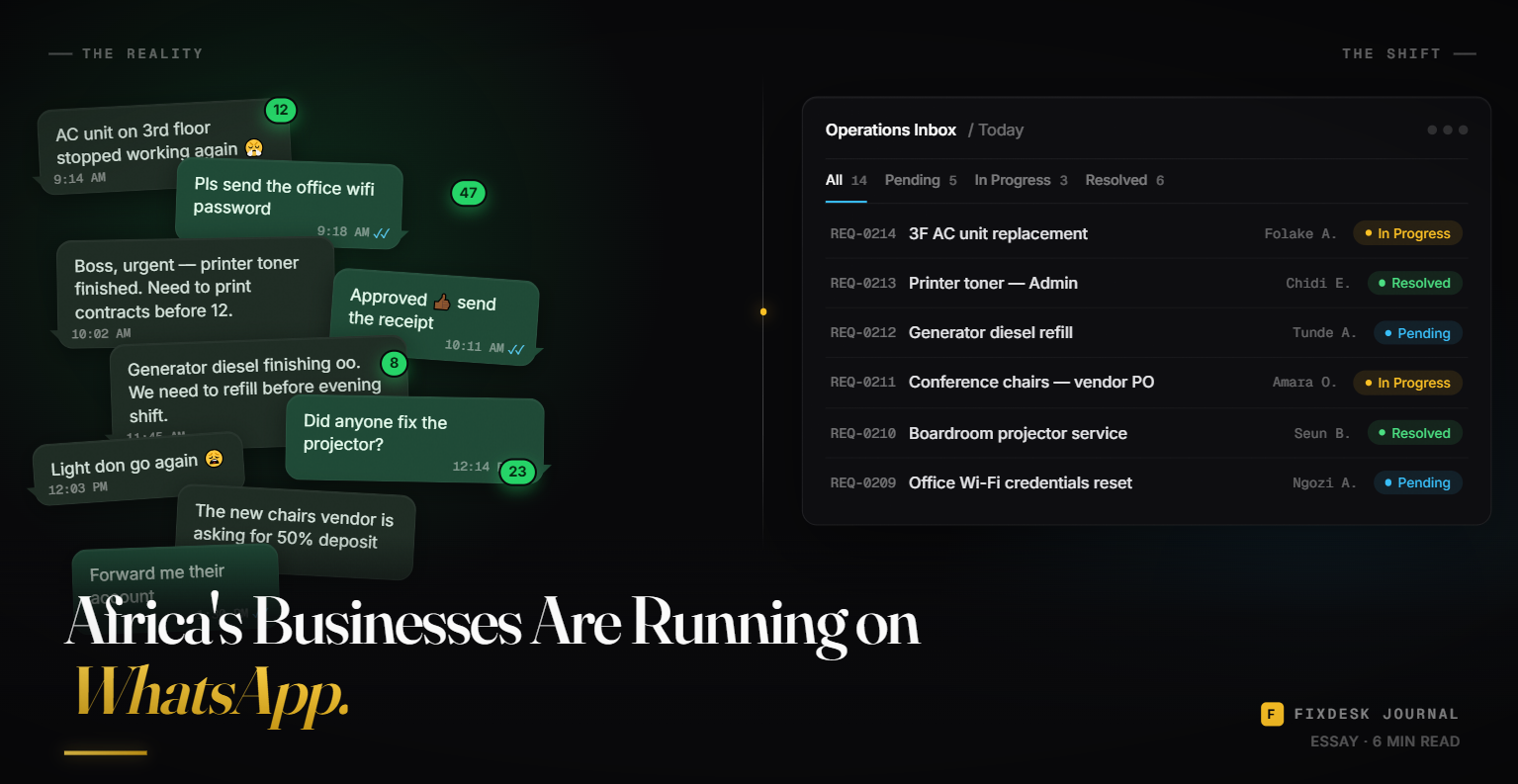
There is a specific kind of meeting that happens in almost every Nigerian organization.
It usually starts with a complaint. An IT request that got lost. A leave application that nobody approved or rejected — it just disappeared. A procurement requisition from six weeks ago that is still "pending" in a WhatsApp thread. A facility fault that was reported verbally, then digitally, then verbally again, and still has not been resolved.
The meeting ends with the same resolution every time: we need to be more organized. And then everyone goes back to the same WhatsApp groups.
This is not a failure of character or commitment. It is a failure of infrastructure. The tools these organizations are using were not built for what they are being asked to do.
39 Million Organizations. One Broken System.
Nigeria alone has 39 million micro, small, and medium enterprises. Behind each of those numbers is a real organization — a school, a construction firm, a real estate company, a manufacturing plant, a hospital, a logistics operation — with real staff trying to coordinate real work across real departments.
Most of them are doing it on WhatsApp.
Not because they have not thought about it. Not because the people running them are not intelligent or capable. But because until recently, the alternative was either too expensive, too complex, or simply not built for how Nigerian organizations actually work.
Global platforms like ServiceNow, Freshdesk, and Zendesk were designed for enterprise IT departments in London and San Francisco. They are excellent tools. They are also priced, configured, and designed for a reality that does not describe a 60-person boarding school in Lagos or a construction firm managing three project sites in Abuja.
So African organizations did what they always do when the right tool does not exist: they adapted the tools they had. WhatsApp became the IT helpdesk. Email became the leave management system. Verbal agreements became the procurement approval chain. Spreadsheets became the operations dashboard.
And it has worked — just barely, just enough, and at a cost that most organizations cannot fully see because the inefficiency is distributed across thousands of small friction points rather than concentrated in a single visible failure.
The Cost That Does Not Show Up on a Balance Sheet
When an IT request gets buried in a group chat, no single person is to blame. The IT officer missed it. The staff member assumed someone was handling it. The department head never knew it existed. The laptop stayed broken for a week.
That week of reduced productivity does not appear anywhere in the organization's records. Neither does the 20 minutes HR spent searching through email threads trying to reconstruct a leave approval history. Neither does the procurement decision that went ahead informally because the WhatsApp-based approval process had no checkpoints.
These are not catastrophic events. They are friction. Small, constant, accumulating friction that adds up across every department, every workflow, every day.
Research on workplace communication overload consistently shows that managing operations through informal channels — group chats, email threads, verbal agreements — creates information overload, reduces accountability, and makes it structurally impossible to build the kind of institutional knowledge that turns a good organization into a great one.
When the right information is in someone's WhatsApp messages instead of an institutional record, it leaves with them when they go.
What Properly Digitized African Organizations Look Like
The organizations that have crossed from WhatsApp-based operations to a proper internal platform look different in a few specific ways.
Staff know where to go. There is no ambiguity about whether to send a WhatsApp message, an email, or call someone directly. You submit to the platform. Full stop.
Management has visibility. A department head can open a dashboard and see every open request in their department, every leave application pending approval, every procurement requisition in the chain — without holding a meeting, without sending a follow-up message, without waiting for someone to compile a report.
Nothing disappears. Every request has a status, an owner, and a timestamp. If something is unresolved after 48 hours, it is visible. There is no version of events where a staff member says "I sent it" and an HOD says "I never saw it" — the system shows exactly what happened and when.
Accountability is structural, not personal. The system assigns ownership. The approval chain routes requests to the right person. The resolution timestamps every action. Accountability does not depend on anyone's memory or honesty — it is built into how the workflow operates.
This is not a utopian vision. It is already how Rugby School Nigeria and Ucalux Development operate today, on FixDesk.
Why Now Is the Right Time
Two things have changed in the last three years that make this moment different from any previous moment.
Internet penetration crossed 50% in Nigeria. For the first time, the majority of Nigerians have internet access. The infrastructure barrier to web-based tools is no longer the primary obstacle for urban organizations — and it is declining rapidly.
The African SaaS market is growing at over 21% annually. There is now capital, talent, and organizational appetite for software built specifically for African business contexts. The question is no longer whether organizations will adopt software — it is which software they will adopt, and whether it will be built for them or imported from elsewhere and imperfectly adapted.
The organizations that figure this out now — that move from informal tools to structured platforms in the next 24 months — will have a significant operational advantage over those that wait. Internal operations infrastructure is not glamorous. But it is the difference between an organization that scales well and one that strains visibly under its own complexity the moment it crosses 50 people.
What FixDesk Is Building
FixDesk is an internal operations platform built specifically for African organizations. Five modules — IT helpdesk, facilities management, leave management, procurement approval workflows, and task management — in a single platform that replaces the WhatsApp groups, email chains, and spreadsheets most organizations are currently running on.
We are not building a local copy of Zendesk. We are building the platform that makes sense for how a 60-person Nigerian school, a 120-person construction firm, or a 200-person real estate company actually operates — with the approval chains, the role structures, and the workflows that reflect their reality.
Rugby School Nigeria is live in production. Ucalux Development is live in production. We are expanding.
What Comes Next
The organizations currently running on WhatsApp will not all shift to structured platforms at once. Change in organizational behavior is slow and happens one pain point at a time — usually after a request gets lost badly enough that someone in authority decides it cannot happen again.
But the shift is coming. The economic case is clear. The technology is available. The infrastructure is in place.
What comes next is an Africa where organizational operations leave a record, accountability is structural rather than personal, and the institutional knowledge that makes organizations durable does not live in someone's WhatsApp chat history.
We are building toward that. And we are looking for organizations that want to be part of the early version of it.
See what FixDesk looks like in practice: explore the Rugby School Nigeria live demo or the FixDesk construction demo, or get in touch to talk about your organization.
Frequently Asked Questions
Is this only relevant for large organizations?
No. FixDesk is built for organizations from about 30 staff upward. The inflection point where WhatsApp-based operations start breaking down noticeably is usually around 40–60 people. Below that, informal coordination mostly works. Above it, the friction becomes visible and costly.
Why not just use a tool like Asana or Trello?
Task management tools solve one piece of the puzzle — the task assignment and tracking workflow. They do not handle IT helpdesk ticketing, leave management approvals, procurement chains, or facility fault reporting. FixDesk covers all five in one platform so you are not managing five separate tools and five separate places for staff to submit requests.
Is FixDesk affordable for Nigerian organizations?
FixDesk is priced for African organizational reality, not for enterprise IT budgets. Contact us to discuss pricing for your organization's size and module requirements.
How long does it take to go live?
Most organizations are live on their first module within a week. Full deployment across all five modules typically takes four to eight weeks depending on how complex the procurement approval chain needs to be configured.